
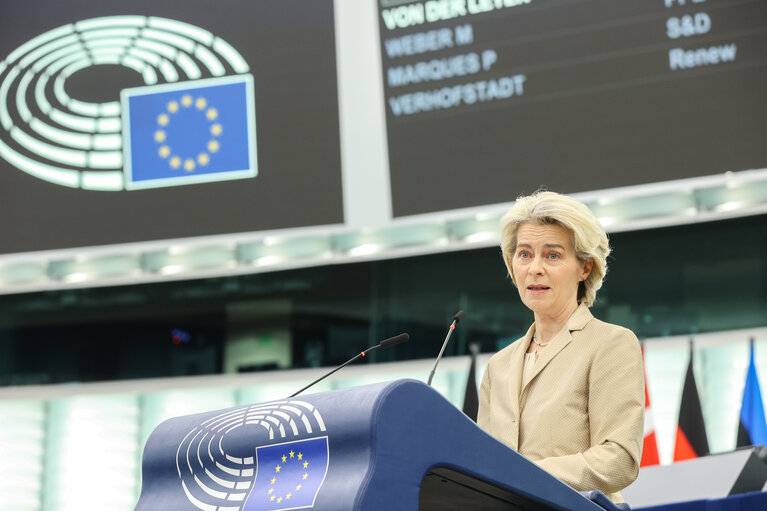
Brussels – The European Commission in February will present its ideas for an institutional reform of the EU in a communication that will be forwarded to the European Parliament and the Council. In front of the European Parliament plenary meeting in Strasbourg this morning, Ursula von der Leyen outlined the timing for the roadmap on political reforms announced a few days ago during the press conference that kicked off the Belgian presidency of the EU.
“This House has already put forth bold ideas for a reform of our Treaties. Next month, the Commission will set out our ideas in a communication to the European Parliament and the Council, ahead of the Leaders’
discussion organized by the Belgian Presidency,” the President of the European Commission confirmed to MEPs this morning (January 17).
The Belgian Presidency and the European Commission are on the same page on the need to make institutional reform a priority. The time has come to think about the Europe of tomorrow: given a significant enlargement that could bring to a 35-Member State Europe instead of the current 27, and also because the June 6-9 European elections will take the Union into a new institutional cycle. The more the European Union enlarges, the more it is necessary to simplify the voting system in predominant matters — such as foreign policy — where there is a risk of continued gridlock.
Where are stand
With today’s communication, the European Commission wants to contribute to a process that, despite being slow, is fully underway. On December 18, The EU Council (the institution where the member states meet at the ministerial level) agreed to forward to the European Council (where the heads of state and government meet) the European Parliament‘s formal request to convene a Convention to reform European Treaties, contained in a resolution adopted by House (slim) majority at the November 22 plenary in Strasbourg.
The Belgian presidency will call on the president of the European Council, Charles Michel, to bring to the attention of the other heads of state and government the issue of revising the Treaties on the agenda of a European summit, probably scheduled for March 21 and 22. The idea is to arrive at the June 6-9, 2024 elections with a clear idea of how to take the discussions forward as the next legislature begins.
Overcoming unanimity voting in some of the matters used today (such as foreign policy and financial matters) is the crux of the demands of the European Parliament for a more efficient and agile European Union on the geopolitical chessboard and in view of new accessions. It would mean fewer deadlocks and fewer stalemates in the European Council, where a single state today can effectively block a decision that the other 26 agree on. MEPs advocate a legislative system that is less unbalanced toward the European Parliament, calling for the right of legislative initiative (now held by the European Commission alone) and increasing the number of decisions taken with a qualified majority in the Council.
As many as five co-rapporteur MEPs, one from each political group, signed the text of Parliament’s demands supporting the proposal: Belgium’s Guy Verhofstadt for Renew Europe, Germany’s Sven Simon for the EPP, Germany’s Gabriele Bischoff for the Socialists&Democrats (S&D), Germany’s Daniel Freund for the European Greens, and Germany’s Helmut Scholz for the Left. Not supporting the reform project, as expected, were the Conservatives and Reformists of the ECR (of which Fratelli d’Italia is a member) and the right-wing Identity and Democracy (of which the League is a member), which oppose the idea of reforming the Treaties.
How to reform the EU
To initiate the process, the European Parliament leverages the so-called ordinary procedure of Article 48 of the Treaty on European Union (TUE), which stipulates that it is the European Council by a simple majority (14 out of 27 states) that decides to convene a convention, comprising of representatives of national parliaments, heads of state or government of member states, the European Parliament, and the Commission. If no drastic changes have to be approved, the heads of state and government can decide, by a simple majority, not to open a convention but only an intergovernmental conference. In case of agreement on Treaty changes, each member state must approve them.
There is currently a bloc of at least 13 member states – Bulgaria, the Czech Republic, Croatia, Denmark, Estonia, Finland, Lithuania, Latvia, Malta, Poland, Romania, Sweden, and Slovenia – that has staunchly opposed amending European Treaties, calling the idea of reforming the Treaties “premature.” The reform process was put back on track after the Conference on the Future of Europe, the unique exercise in participatory democracy in the history of the EU that for nearly twelve months brought 800 citizens — casually selected from all twenty-seven member states — to discuss the future of the European Union and to identify what priorities to go with to make the EU integration project more robust.
From the conference came a direct call, through the 49 recommendations, to open the convention, but even though the initiative was supported by governments with the political clout of Germany, France, and Italy, the initiative effectively stalled, held back by smaller states, which are appealing for the guarantee of veto power to have more political clout in the Council, where otherwise they risk “disappearing.”
Reforming the Treaties is not the only way to rethink the European Union, it is possible to take advantage of so-called “passerelle clauses” to move to qualified majority voting in certain policy areas where unanimity is now required. The option is a procedure introduced by the Lisbon Treaty that allows European Treaties to be amended through a simplified mode, allowing the European Council to vote on the individual amendment proposal without unanimity of the states but with a qualified majority. In a communication following the Conference on the Future of Europe, the Commission supported this approach in energy, taxation, and important aspects of the Common Foreign and Security Policy such as sanctions and human rights.
English version by the Translation Service of Withub